May 9, 2025
What Is AI Process Automation and How Are Businesses Using It?
In an era where consumers are bombarded with countless marketing messages each day, personalization has emerged as a beacon of relevance and connection.

.png)
Businesses have been automating work for decades using workflow tools, rule-based triggers, and scheduled reports that have existed in various forms since the early days of enterprise software. What has changed is the quality of judgment
those systems can now exercise, because artificial intelligence does not simply execute a fixed instruction - it can assess variable inputs, draw on patterns from prior outcomes, and adapt its behaviour as conditions change. When applied to business processes there is a significant shift in capability is significant, meaning that the category of work which can be reliably automated has expanded well beyond the repetitive and the predictable. This guide examines what AI process automation is, how it differs from the tools that preceded it, and how organisations are deploying it today to reduce operational drag and build capacity for more meaningful work.
AI process automation is the use of artificial intelligence to identify, replicate, and continuously improve repetitive business processes - without requiring constant human input to operate them.
It sits above traditional automation (think rule-based tools that follow fixed instructions) and below full AI autonomy. The difference is judgment. AI process automation can handle variability, learn from outcomes, and adapt to changing conditions in ways that basic workflow tools cannot.
In practical terms, it looks like:
None of these require a developer standing by. Once designed and deployed correctly, they run - and they report back.

The businesses getting real traction from AI process automation share one thing in common: they started with the process, not the technology.
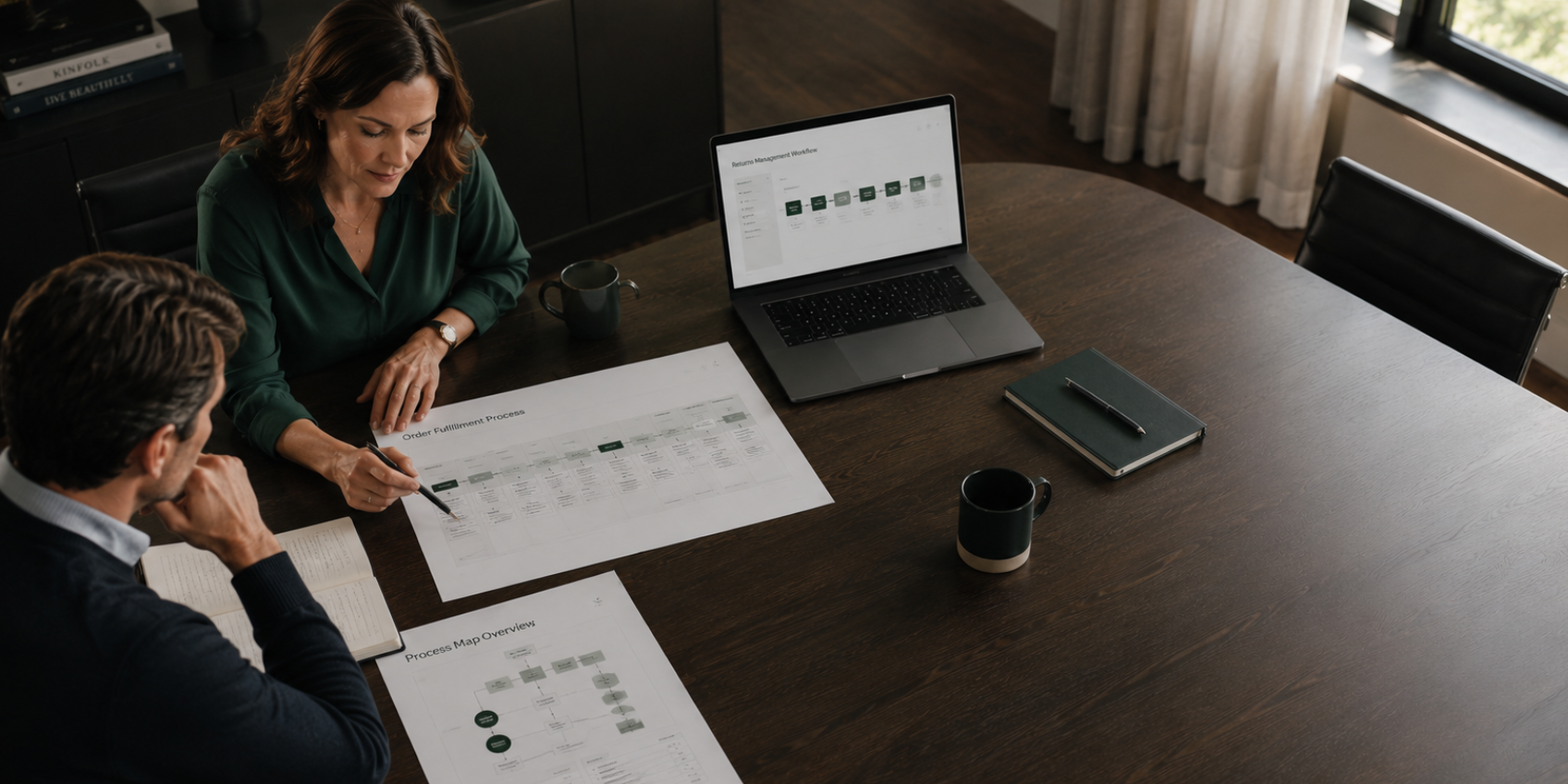
Before any tool was selected, they mapped what was actually happening - where work was being duplicated, where information was being re-entered, where delays were structural rather than individual.
Lead handling is one of the highest-impact starting points. When leads arrive through multiple channels and each one requires manual logging, response time suffers. Businesses that automate lead intake see response times drop from hours to minutes, with full audit trails and zero data entry.
For professional services firms, consistency in client communication is both a quality issue and a risk issue. Automated sequencing - triggered by matter stage, not by memory - reduces the administrative load on fee earners while improving the client experience.
Manual reporting is one of the most common bottlenecks we see. Leaders spend hours compiling data that should be surfacing automatically. AI-supported dashboards allow leadership teams to see operational performance in real time - not at the end of the month after the decisions have already been made.
Approval chains that rely on email threads and verbal confirmation are a governance risk at scale. Structured AI-assisted workflows create clear ownership, time-stamped records, and consistent escalation paths - without adding overhead to the team.
The question isn't whether automation is available. It's whether your processes are structured clearly enough to automate well.
AI process automation fails when businesses treat it as a technology project. They buy a tool, onboard it quickly, and wonder why adoption is low and output is unreliable.
The organisations getting sustained results approach it as an operational design exercise. They:
That sequence - diagnose, design, deliver - is the reason some businesses see a 25% reduction in manual workload within the first 90 days, while others end up with expensive software that no one uses.
Most founders and leadership teams know they need to move faster. They also know that the last technology project cost more than expected and delivered less than promised.
AI consulting bridges the gap between capability and execution. It's not about selling a platform. It's about understanding how your business actually moves - where decisions are made, where handoffs break down, where good people are doing work that a well-designed system should handle - and then building something that holds.
The role of the consultant is to protect you from two failure modes: buying too early, before the process is understood, and implementing too slowly, while operational drag compounds.
Winston Gray works with founder-led and mid-market businesses to identify where AI process automation can remove drag, reduce manual workload and create the operational visibility that supports you to make educated decisions on your business.
Every engagement starts with a diagnostic, we map current-state operations, identify the highest-impact automation opportunities, and then design and deliver a solution that your team actually adopts (we also have a great change management team).
If you're ready to understand where your business is leaking time and what it would take to fix it, explore The AI Build
Our latest news and trending topics